When communication fails, strategy becomes noise

Communication sustains culture, governance and predictability. But why, in practice, does it still fail where it matters most?
There is a structural problem that cuts across companies of different sizes and levels of maturity, yet tends to be underestimated: the existence of communication silos. This lack of communication can appear both between areas and in how information cascades between different levels within the same team, and it can take on even greater dimensions when it occurs between headquarters and branches, or between global and local instances of the same company. In practice, the effects are always larger than they seem and are directly tied both to governance and to culture as one of the main engines of individual, team and institutional growth.
In a paradoxically silent way, day after day, communication failures gradually become not a mere operational obstacle, but an anti-strategic and anti-synergistic noise capable of delaying or preventing results. These silos do not arise out of bad intention, but from a lack of systemic awareness. The first symptom is that each area starts operating with its own logic, its own deadlines and priorities, without a clear view of what is happening around it. And worse, without understanding the real meaning of collaboration, as if there were no objectives common to everyone involved.
The most immediate effect is internal noise. One area, one regional office or one branch does not know what is happening in the other. People on the same team do not understand their role, or even the relevance of their colleagues’ work to reaching the macro goals. From there, the symptoms and effects worsen: decisions are made based on partial information. Adjustments are made without understanding cross impacts.
Over time, an even more serious problem arises: the disparity between what senior management believes is happening and what is actually happening in the operation.
This distance between strategic vision and operational reality is one of the main drivers of mistaken decisions. Not for lack of intelligence, but for lack of communication connected to context, intention and process. No company can scale in a healthy way when each part sees only a fragment of the whole.
The symbiosis between communication and governance
The relationship between communication and governance is symbiotic: governance provides the ethical and decision-making structure, while communication is the mechanism that makes this structure visible and trustworthy for the whole company and, on a larger scale, also for the market and for society as a whole. While governance organizes the decision, communication ensures that it is legible, replicable and coherent across the entire structure. It is in this interdependence that the architecture of decision is formed, capable of creating predictability without freezing the system.
It is only through this mutual support that decisions cease to exist merely at the level of intention and begin to structure behaviors throughout the system. To lead is not just to decide, but to ensure that criteria, priorities and limits are understood, interpreted consistently and applied at the right time. When this support does not exist, governance is weakened. Decisions lose backing, come to be reinterpreted imprecisely or executed without alignment.
The most sensitive link in this architecture is middle management, where the real test of governance’s reach lies.
While senior leadership holds the strategic vision and the base carries out execution, it is at the intermediate level that the “translation bottleneck” occurs. For governance to work, communication must therefore equip these managers so that they act as governance ambassadors, capable of decoding the ethical and strategic rationale behind decisions. If this layer of leadership does not have the fluency to explain the “why” of a guideline, governance dies halfway, turning living culture into inert bureaucracy and allowing execution to detach from its original purpose. If this layer does not sustain the decision, who does?
In many cases, noise happens not for lack of messages and touchpoints, but for the absence of a more present governance, as a living function of the system. In many organizations, this happens because of the lack of an instance capable of keeping people aware of what is meant to be achieved, of how their decisions connect to the whole and of which criteria guide priorities over time. This goes far beyond the mere transmission of information.
Without clarity, without decision logic and minimal agreements about responsibilities, communication becomes episodic and reactive, widening the gap between strategic intention and everyday practice.
It is not enough to inform: frameworks and playbooks to build understanding
To speak is not the same as to be understood. Communication is part of the management infrastructure and requires clarity about the result it is meant to generate.
It is precisely at this point that two inseparable fronts come in: the framework and the playbook.
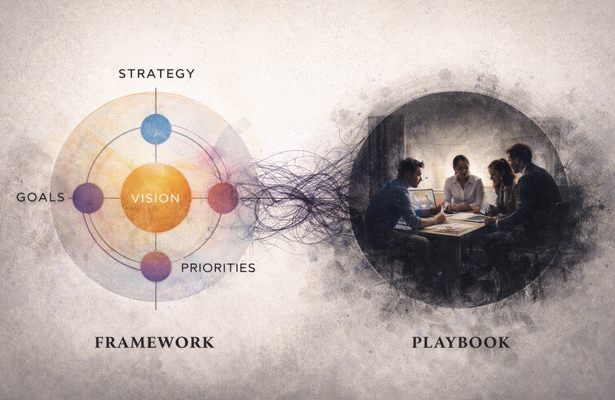
The framework represents the vision. Where the company wants to go. What the strategic purpose is. What the real priorities are. What is at the center and what is on the periphery. The playbook, in turn, is what brings this vision to life. It is the mechanism that translates strategic thinking into everyday practice.
A framework without a playbook becomes an elegant speech. A playbook without a framework becomes blind execution.
When framework and playbook are not connected, the company lives in permanent dissonance. Leadership says one thing. The operation lives another. And, in that gap, interpretations, improvisations and misalignments arise.
A living playbook answers essential questions that reduce noise and increase autonomy. What to do. When to do it. Why to do it. How to do it. Through which channel. At what cadence. And, above all, how to decide when something falls outside of what was expected.
Without these answers, communication becomes abstract. With them, it becomes applicable, auditable and open to adjustment.
Show, don’t tell: turning discourse into concrete acts
There is a principle widely used in film screenwriting techniques that applies perfectly to corporate reality: show, don’t tell. Some things should not be explained, they should be shown. They are not communicated through discourse, but through actions, scene after scene, carrying the narrative forward. It is not enough to say that something changed. You have to show the change happening.
Many objectives pass through intangible dimensions. Performance, efficiency, profitability, quality and engagement can bring relativizations, nuances, or even difficulty of visualization. These concepts need to be translated into examples and actions that impact people’s day to day.
To mobilize, communication must become concrete. This materialization requires reading the environment. Before communicating, the leader needs to understand the surroundings, the elements involved, the formats, the people and their contexts. Only after that is it possible to take a clear stance. To show what each thing represents. To show what changes when something goes out of place, the real impact on the team’s life. This serves not only to reach results, but to raise awareness, sensitize and engage, avoiding noise.
Methodology makes a difference. Sometimes a long document freezes and tires, though it may be necessary for certain audiences and contexts. In other cases, a short audio is more effective. Lean slides can work better than an endless sequence of messages, but a series of pieces of content can give the interlocutor more time to digest ideas.
Communicating is not the end of the process. It is the beginning.
You have to assess whether the message was understood, to what degree it was assimilated and whether it generated the expected reaction and execution. Otherwise, the method needs to be adjusted.
Perhaps the true thermometer of communication is not measured by the number of messages sent, nor by the sophistication of the channels used. It reveals itself in the quality of the decisions people are able to make based on what was communicated.
When there is clarity, context and intention, communication sustains culture, reduces noise and creates predictability. When there is not, the organization operates by improvisation, even while believing it is aligned. It is worth reflecting: is the communication that sustains your company today expanding awareness and autonomy, or just taking up space in the routine?