Fascinated by artificial intelligence, we are ignoring the essential
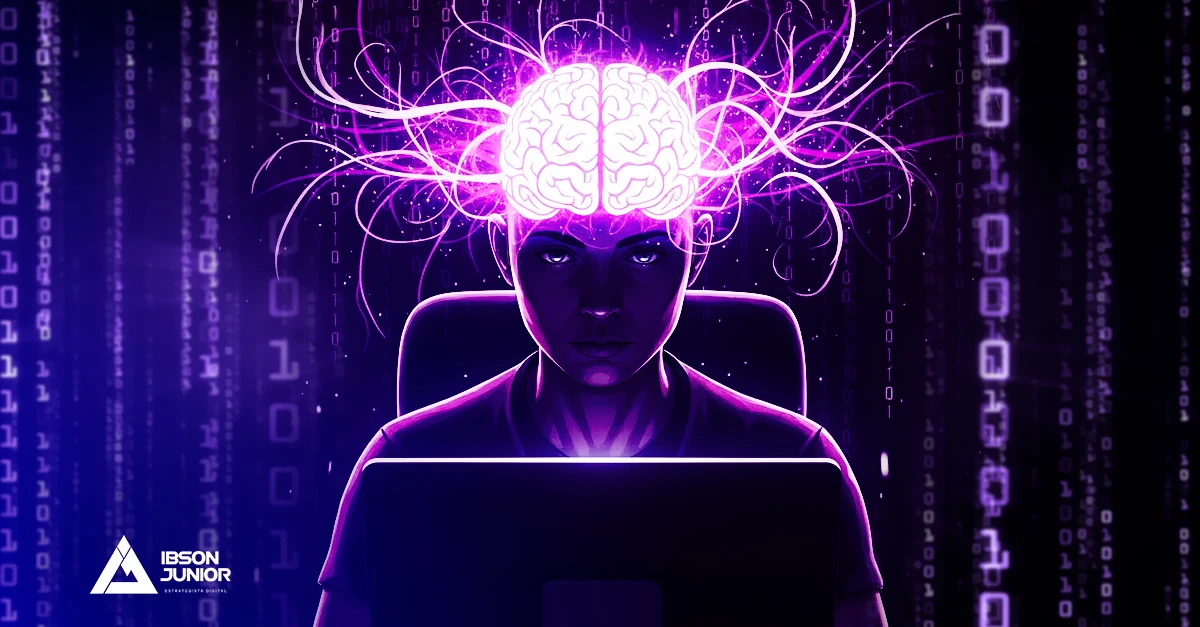
When we do not assess ourselves frankly, we cannot lead our own lives. And no technology will solve that.
In recent times, I have been following a flood of content about artificial intelligence (AI) in podcasts, talks, articles, series and books. It is a fascinating and important theme, no doubt. But, while we dive into this technological universe, I notice a growing void: we are setting aside emotional intelligence (EI) and even the way it can interact with technology and with cognitive intelligence, enabling important advances for humanity. More and more people are outsourcing to technology what they should develop within themselves, attributes such as empathy, sensitivity, reading of context.
AI does not replace emotional intelligence, but depends on it. When EI is missing, the machine occupies a place that is not its own and distances us from the human essence. When emotional intelligence exists, artificial intelligence gains purpose and power. And this reflects in something I consider essential, in any aspect of life: self-leadership.
More than leading teams, self-leadership is present in the small and big things, including in what seems unimportant in the face of a demand for results so full of numbers, robotic processes and KPIs. Often, this demand for performance and results goes beyond corporate life and takes over our own lives. Here, I talk about leading your own week, knowing how to give your best each day and recognizing that yesterday’s best will not be the same as tomorrow’s, seeking balance.
Each context demands a different version of our own strength and its constant refinement. The challenge of emotional intelligence is to discern when we need focus, calm, reasonableness, and when we are simply mixing emotions with guidance and feedback for the team, in our relationships, or even in the way we see ourselves.
Are we able to truly listen to what the other is saying, without letting emotional noise distort the message? This is perhaps the central question of emotional intelligence: to separate what we feel from what is being said, in addition to silencing the external noise, so as to act in an assertive, productive and human way, in every sphere of life. When we cannot do this, emotional wear accumulates and the body begins to react even before consciousness, creating fertile ground for continuous stress and loss of mental clarity.
Mental illness: a collective bill
According to the World Health Organization (WHO), Brazil has the largest number of anxious people in the world, 18.6 million Brazilians (9.3% of the population). According to the National Association of Occupational Medicine (Anamt), about 30% of professionals in Brazil present a picture of burnout. The country today ranks second in the world ranking of diagnoses of the syndrome.
We live in an era of collective exhaustion. Stress, depression and anxiety have become ordinary words. People are overloaded, emotionally drained. Companies, often, reinforce this cycle instead of interrupting it. In this scenario, the absence of emotional intelligence is not just a behavior problem, but a factor that accelerates the wear of mental health, because it makes it hard to recognize limits and ask for help at the right time. Worse: bombarded by competitive stimuli and unrealistic standards on social media, including by images created by AI, people pressure themselves more and more to turn their own hobbies and leisure into performance.
The bill for this great exhaustion is already arriving, but who will pay it? According to the Ipsos Health Service Report 2025, 52% of the population in Brazil states that mental health is Brazilians’ greatest concern: a growth of 34 percentage points compared to 2018, when 18% pointed to emotional well-being as a priority.
The bill is not merely individual, but collective, and companies have a lot to do with it. However, self-knowledge, self-mastery and emotional intelligence at the individual level are fundamental for the cascade effect of behaviors.

The role of leadership: perceive, welcome, guide
Emotional intelligence is the invisible foundation of good leadership. And it is, in many ways, what differentiates us from machines and algorithms. There are many anxious leaders and micromanagers. Others, hostages of their own temperament, confuse pressure with efficiency. And there are those who never learned to welcome, because they were never welcomed. Good leadership, however, begins in self-knowledge.
A leader should not just delegate tasks, but perceive the emotional state of their team. Understand when someone is fragile, vulnerable or going through a personal problem that interferes with performance. More than demanding results, you have to know what to communicate, how to communicate and when to communicate.
The way of saying is what defines whether feedback will be received as an attack or as an opportunity for growth. Leading, in this sense, is a constant exercise of reading and listening: reading the scenario, the context and the individual. After all, the emotional interferes with results; but, before that, it interferes with people’s lives.
A leader without self-perception is like someone driving at high speed without seeing the rearview mirror. It is not about mastering management techniques, but about mastering oneself. Whoever has more emotional balance has more responsibility. Precisely because they see farther.
Another point is the lack of perception about the other and about the whole. I like to think of the metaphor: whoever does not hear the music finds it strange to see others dancing. Emotional sanity allows us to hear this music, to perceive the rhythm of the environment, the mood of people, the tone of situations. When this listening fails, the body often begins to react with signs of constant tiredness, irritability and loss of energy, indicating that something emotional has already gone off track. Without it, we are like the fish that does not know air exists, precisely because it lives inside the water and dies quickly outside it.
Whoever does not burst the bubble loses the capacity to see the whole, to understand what is really happening around them. And how to act.
Attention, time and truth: the tripod of human management
Emotional intelligence is, above all, about giving time and attention. Before correcting someone, the leader needs to understand the context. Is it a lack of preparation? Is it excess of load? Is it something personal? This careful reading also protects the team’s emotional health, because it prevents punctual tensions from being treated disproportionately and becoming permanent fear.
Being an open door to dialogue is the first step to transform a relationship. But this is only possible when the interest is genuine, and not a strategy of manipulation and control disguised as empathy. When care is true, it awakens belonging and trust. When it is false, it produces disengagement and lukewarm delivery. Whoever does not have time to listen to people does not have the profile to manage people.
Feedback itself ends up being poorly used because of the lack of emotional preparation. It only works when it guides growth, and not when it judges or condemns. An emotionally intelligent leader adapts the form, the moment and the tone. They understand that each person reacts differently, depending on their emotional state and their history.
Feedback is not about pointing out errors, but about building clarity. It is the space where the leader says: “I see what is happening, I give you time to breathe and then we walk together.” This kind of dialogue is what transforms teams and creates emotional maturity within the culture.
Culture and leadership: between discourse and practice
Emotional intelligence needs to be embedded in the organizational culture, not as an HR program, but as a lived value. There is no point in offering benefits such as a gym or therapy sessions or creating decompression rooms if, the next day, the environment goes back to being oppressive. Culture is only alive when it is practiced. And this begins with leaders, who are its guardians. It is they who need to monitor whether the discourse of “taking care of people” translates into real actions.
In many cases, true care is not in collective dynamics, but in individual gestures: a day off granted at the right time, a frank conversation, an adjustment of load, a recognition. To care is to act in a human way, not a symbolic one.
There is a siren that no one hears. It sounds in the leaves of absence due to burnout, in the meetings without purpose, in the messages sent outside working hours, in the automatic decisions made without listening.
It is the same siren that appears in insomnia, in the lack of energy and in the constant feeling of being at the limit, even when the body still insists on going on. But we are anesthetized, believing that productivity is synonymous with rushing. And, in this noise, the human gets lost and, frequently, talents too.
Whoever has not yet realized that emotional intelligence is the true protagonist of life remains a hostage of autopilot, reacting more than choosing. Whoever has heard the siren and decided to develop this awareness lives another reality. They reap the fruits of lucidity, quality of life and healthier relationships. And, if that someone is a leader, they also transform their team’s journey, because an emotionally mature leader not only improves results, but elevates people.
The world runs on ever faster treadmills, but without a pause, there is no clarity. To have emotional wisdom is to have rhythm. It is knowing when to accelerate and when to walk. Corporate life is not a 100-meter race, but a marathon. And whoever does not know how to dose their breath loses the way.
The leader as a mirror and the return to consciousness
In the end, emotional intelligence is the oxygen of leadership. Without it, there is no breathing room, no clarity, no connection. It is what allows the leader to act with humanity, understand contexts, respect limits and inspire by example. Culture is strengthened when there are balanced leaders, because the balance of one reverberates in all the others. Artificial intelligence may even help us predict behaviors, but it is emotional intelligence that allows us to understand them. And it is on it that the health depends, not only of companies, but of the people who build them every day.
The siren keeps sounding. And, while some ignore it, others have already begun to hear it. It is these who will lead the next generations of leaders: more conscious, more human and, for that very reason, more prepared for the future. And you, how do you assess your emotional intelligence? And how do you perceive the emotional intelligence of your leaders and team members, of the people around you? Do you think you could develop yours better?
I invite you to follow me, like and share this article so that the algorithm does not separate us without reason. I will share more tips and insights about this in the coming weeks and it would be a pleasure to have interesting exchanges in the comments of my posts.