When profession becomes identity, the person starts to disappear
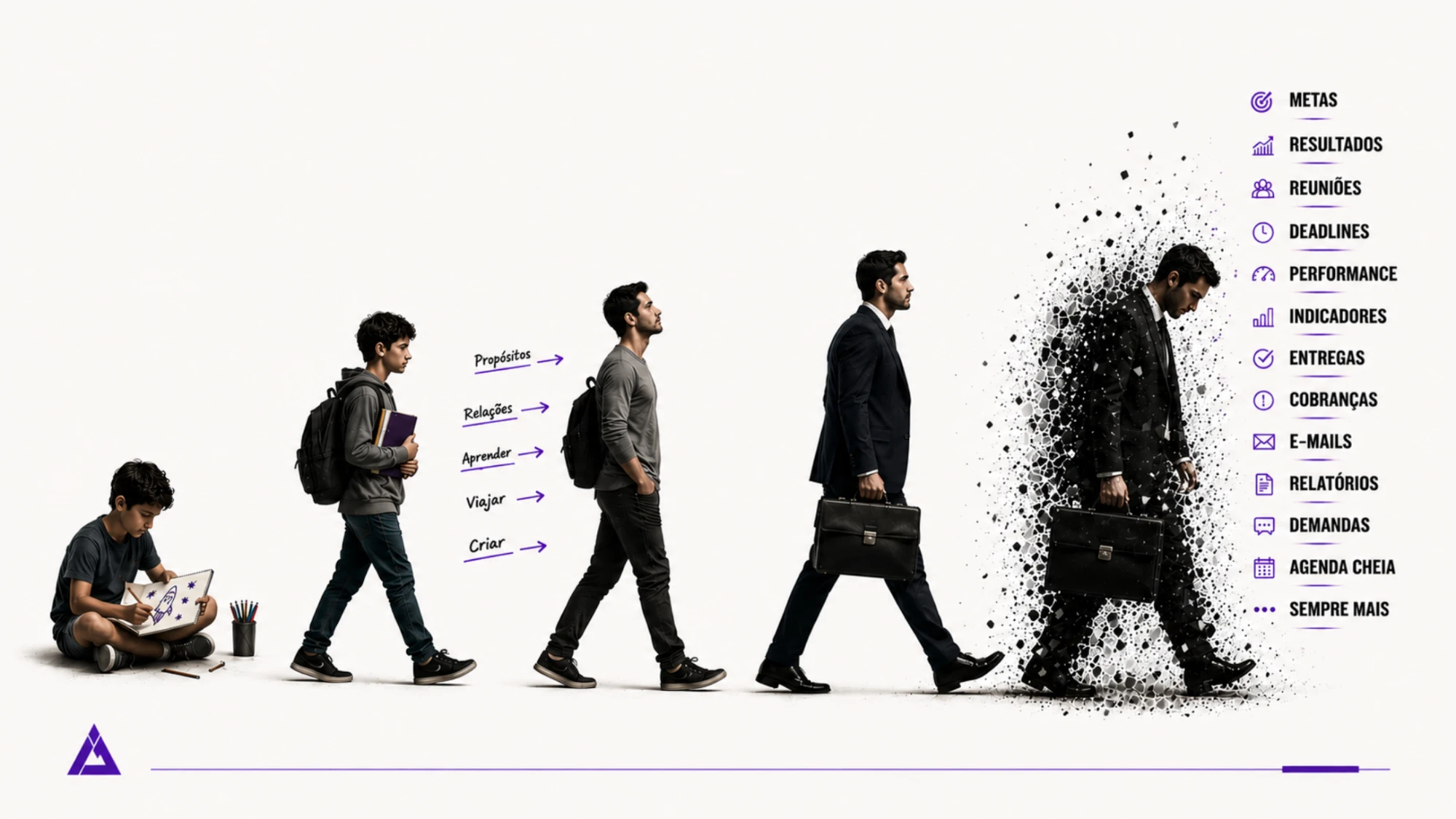
Performing well at work is one thing. Being only the work is another, and the price of that, silently, is depth itself.
Who are you? In the face of this seemingly simple question, the number of people who begin to define themselves by answering precisely what they do, regardless of the context of the conversation, is enormous. You may be at a barbecue, at your children’s school festival, at the gym, or interacting with new people at a bar, but you have surely caught yourself presenting yourself as your profession, your education, your position, or what your company does. Within the corporate and professional scenario, we know little beyond the favorite team or other small characteristics of our colleagues and interlocutors. Although it is healthy to know how to separate personal life from work, the point is that not only do we get to know and communicate with people in an increasingly shallow way, but we also perceive that excessive focus on goals often dehumanizes and reduces us.
This text is not a criticism of work, nor a defense of a life without ambition. It is a provocation about identity, repertoire and personal governance. Because the more complex organizations become, the more dangerous it becomes to confuse function with existence.
Paradoxically, understanding work as the only territory of ourselves erases not only our authenticity, what makes us unique and our different ways of contributing to the world, but it also limits us in what we do professionally. Even if this does not yet appear in the KPIs and is not recognized as a problem, it is clear that something is narrowing. The repertoire has shrunk. Creativity, which has always depended on unexpected connections, lost raw material. Real presence was replaced by a permanent activation that does not rest and that does not create new mental spaces, new learning paths for the neurons.
And when the repertoire shrinks, the person does not lose only creativity. They lose perspective.
Without a rich inner life, mental space for creative idleness, personal projects and a human repertoire that is not leftovers within us? What do we have to add to the projects we are in? By studying how the brain generates new and useful ideas, the neuroscience of the last decades discovered that the culture of hyperactivity and permanent focus is counterintuitive for creative thinking, which does not emerge from concentrated effort. Creativity emerges precisely from the interaction between two seemingly opposite mental states: spontaneous association, the one that happens when the mind wanders, and deliberate control, when you organize and evaluate what emerged.
According to Nature magazine, at the center of this process is the Default Mode Network, the brain network that activates when there is no external focus. When the person is in the shower, looking out the window, walking without a destination. It is in this state, and not in the middle of a meeting or with a deadline in mind, that the brain makes the most unexpected and fertile connections. The greater the capacity to alternate between this spontaneous mode and the executive control mode, the greater the measurable creative capacity of that person.
In other words: the mind that never rests never truly creates. It only executes.

And execution without consciousness, however efficient it may seem, remains just movement.
The mind on autopilot: where and how we lose ourselves between productivism and productivity
Someone who confuses themselves with their own profession, or with the system of work itself, confuses productivism with productivity. They do not make this decision consciously or at a specific moment. This person simply is not awake: they are 100% immersed in their own routine, inserted in a kind of production line by pure social, economic and cultural automatism. They are trapped in their own loop, without even understanding the need for a pause or an exit. Even if this production line seems much more sophisticated and glamorous than that of a factory worker with repetitive functions, these are quite similar alienations.
Plato described this with disconcerting precision 2400 years ago. In the Allegory of the Cave, prisoners chained since always face only a wall. Behind them, a fire projects shadows of objects that pass by. For them, these shadows are reality, the only one they know, the only one they can name. No one questions, because no one even knows there is something to question.
It is clear that it is legitimate and necessary to focus on goals to grow, as well as to track your own performance at work, to pursue excellence in deliveries. The problem begins when this objective stops being a direction and becomes the only source of meaning in life.
When this happens, the career stops being a path and becomes a cell, even if it has a beautiful badge, a high salary and a full agenda.

At this point, any achievement generates momentary relief, but not fulfillment. It is as if we were in an addictive video game, activating our dopaminergic system always in search of immediate rewards, but which never reaches a greater purpose and never leaves us satisfied. The next goal is already positioned before the previous one is even digested. And what seemed like a path gradually reveals its real nature: a treadmill. You are inside. You are in motion. But you are no longer in control, in governance of your own life.
The most serious symptom is not exhaustion, or even burnout, but what comes after all of this and can settle in over the long term if there is no change of consciousness: hardening. After a while inside the treadmill, the brain gets used to it and reprograms itself. Cognitive intelligence begins to understand this mechanical reality as the only way to exist.
And, when this happens, the question “does it make sense for me to really be here?” stops being formulated. Not because it was answered, but because it was erased. This is, in my view, the true impoverishment. Not the lack of time, not the absence of vacations, but the loss of the ruler over the whole. The inability to look at one’s own life with frankness and assess: what am I building here? What person am I becoming?
Total performance is the beginning of superficiality
There is a dangerous mechanism disguised as virtue: the transformation of all of life into performance. This phenomenon begins at work, but quickly contaminates people’s lives as a whole and can contribute to physical and mental illness, much more than to their well-being. More than that, the obsession with performance and results in everything, in addition to the excessive comparison stimulated by social media, tends to take us out of the real focus and transfer us to a constant race in which we lose the sense of priorities.
The gym we attend for health becomes merely a goal of muscles. The reading of books that supposedly broaden our horizons becomes a goal of pages read. The vacation trip becomes an agenda item and a trophy of status on social media. Even self-care, when it passes through the filter of performance, ceases to be restoration and becomes one more delivery, one more indicator to be optimized. As we saw, this is also counterproductive for work: no one will be able to think outside the box if they are behaving all the time as if they were in a laboratory, in constant testing.
The problem is not in having goals. It is in the absence of contentment, that ability to recognize when enough is enough, when the process is being good in itself, when the achievement does not need to be validated by any external metric. That is when performance ceases to be a consequence of what the person is building and becomes an obsession with demonstration. And then what was growth becomes display. What was dedication becomes compulsion. And the person, paradoxically, works harder than ever, while becoming less present, less interesting, less deep. More predictable.
The person starts by trying to be excellent. Then they try to be admired. Finally, without realizing it, they start living as if they were always being evaluated.
The best performance I have ever observed in people and organizations is not the one that was pursued by that name. It is the one that appeared as a natural consequence of someone who dedicated themselves to doing well something that made sense. Without the ambition to be seen during the process.
Perhaps the contemporary challenge is precisely this: to go back to treating performance as a consequence, not as an identity.
Personal governance for the governance of life: practical learnings and self-knowledge
There is a principle I learned throughout life, in practice, and that increasingly guides what I think about leadership, career and development, in addition to my own personal life: personal governance precedes the governance of anything else. This is not self-help discourse, but a pragmatic finding.
Whoever does not invest in themselves, in developing self-knowledge, in building repertoire, in creating real space for reflection, arrives in the professional territory with insufficient tools. They may occupy relevant positions. They may execute well for a while. But at some point, the absence of this foundation appears. In decisions that become reactive, in leadership that does not sustain vision. In an identity that needs permanent external validation to exist.
I do not tell this to turn difficulty into a medal, nor to romanticize scarcity. I tell it because some phases of life only reveal their value after we understand what they formed in us.
Before entering this part, I think it is important to make it clear: I do not share this to turn difficulty into a medal, nor to romanticize scarcity. I share it because some phases of life only reveal their true value when we understand what they formed in us.
I do not intend here to place myself in a position of superiority and I understand that there is a multiplicity of stories and contexts, but I would like to share a little about myself, because I believe it may create identification with people. When I arrived in Rio Grande do Sul, where I still live today, I had only R$ 200 in my pocket, plus guaranteed housing. It was really very little money, but I had traveled from the Northeast already with the promise of a job in agriculture, to work on my father-in-law’s property.
Beyond that symbolic money, however, I had another baggage: more than 40 courses in different areas, since my first quite exhausting job as a call center attendant, always pressured to take care of my own money and make it grow, even without any prior financial education. And it was exactly there on the plantation, in that place that no one would call an environment of development, that I began to truly develop myself: precisely because I had time to think. No one pressured my mind. While I was with the machete in hand cutting sugarcane for hours on end, I was thinking about how I could develop myself. From that, I made my own choices and started my projects with intention.
The determining factor is that at no moment did I place that challenging and even adverse situation as something permanent. I saw in it an opportunity. Apparently, I was a Northeasterner with R$ 200 in my pocket working in the fields, but what I had internally was much bigger: no one noticed my self-development, but that was what mattered most.
Using that time to think, I managed to rationalize what was really voluntary and which of my beliefs and actions were automatic or supposedly obligatory. I was able to understand how prepared I was to deal with each thing, but I needed to do the exercise of stepping out of myself to look at my own self acting in life. I am not referring only to immediate performance and benefit, but to something greater. Ever since I worked as a telemarketing operator and needed to hit goals, I asked myself how to be one of the first and prepared myself to absorb the feedback. I needed to develop myself in sales and communication, even to talk to my manager.
But there was a layer prior to all of this. Perhaps the most important unlocking of my life was to look with honesty at the mark left by a maternal abandonment. Not to turn that absence into identity, nor to use it as a permanent explanation, but to understand which answers I had been trying to build from it.
For a long time, part of my inner movement was tied to a silent need to prove worth, build autonomy and seek emotional security through achievement. Perceiving this was decisive. Because, as long as we do not name certain marks, they keep participating in our decisions without asking permission.
Facing this story with maturity helped me to leave emotional denial and to know myself better. Not as someone defined by a pain, but as someone capable of transforming consciousness into choice, absence into direction and experience into responsibility over their own life.
Today I understand that self-knowledge does not erase the story. It changes the relationship we have with it.

My professional growth became increasingly greater and more visible as I stepped out of autopilot, got to know myself better as a person and began to see myself beyond deliveries and the immediate professional everyday.
This is perhaps one of the central points of this article: when a person begins to understand what moves them, they stop merely reacting to life and start to better govern their own choices. I do not believe in formulas, but I believe that the sum of good choices in personal development can enable us to reposition ourselves anywhere, at any time. It is a continuous work, perhaps the most important of all, and certainly one of the most demanding and irreplaceable.
Repertoire is not a luxury, but the raw material of everything
When I ask what differentiates people who manage to make decisions with depth from those who merely react, one of the most consistent answers I find is not in technical training nor in seniority. It is in the human repertoire.
Repertoire is the set of experiences, references, life experiences and perspectives that a person has accumulated outside their immediate field of action. It is what allows connecting what apparently does not connect. It is the raw material of creativity. I am not talking about the creativity reserved for artists, but the creativity that anyone needs to solve problems, read contexts, communicate with depth and make decisions that are not merely reactive.
Whoever lives exclusively within their own professional area gradually loses this material without realizing it. What today seems like a detail such as not having read anything outside your immediate area in recent months: not having cultivated an interest that does not yield profits, not having had a conversation that did not revolve around work, everything accumulates like a silent debt. When you need depth, it simply is not available.
Depth does not appear by improvisation. It is built before the urgency.
A joint study by the University of East Anglia and Erasmus University Rotterdam concluded that those who cultivate hobbies intentionally become more creative and find more meaning in their own work. The effect was so consistent that it surprised the researchers themselves, since the impact on professional results was greater than the impact on the participants’ personal lives.
The study shows that it is practically only outside the tension of delivery that the connections arise which no method, no meeting and no framework can produce on demand.
Want an example? Think of two people who receive the same five ingredients in a kitchen: one makes the basics, the other makes five different dishes. The difference is not in the ingredient, but in the repertoire. In how many other moments, other techniques, other flavors were accumulated before. In organizations, this repeats itself all the time, because whoever has repertoire creates access. They create connections that others do not see. They reach solutions that were not in the script. Whoever does not have it, repeats.
Deep musculature: how to exercise new fields of interest outside work
People who navigate in depth at work, in relationships and in decisions usually have one thing in common: they intentionally cultivate something that does not need to yield anything. It can be contact with nature, a sport for leisure or simply allowing oneself the Italians’ dolce far niente (sweet doing nothing). It can be silence, not as a productivity technique, but as a real space for inner listening: that moment when you are not processing, not reacting to a stimulus, not managing the image you project.
It is in this space that identity consolidates. Not in meetings, not in results, not in promotions, but when the person is with themselves enough to know themselves, whether in what they are building, in what they are neglecting, what they still want to learn, what they need to abandon.
There is a specific quality that emerges from whoever maintains this kind of cultivation: the ability to be fully present. To enter a conversation, meeting or negotiation, and really be there. Not responding to parallel stimuli. Not with the mind already on the next item of the agenda, but fully there. This presence is not a technique. It is the natural result of whoever has not outsourced all of their attention to the system.
Self-interested, interested, interesting: which one are you?
There is a distinction that is rarely made clearly, but that greatly differentiates the people with whom it is worth working, talking and learning. This also completely changes other people’s perception of us and the quality of the bonds and learnings we create, of the results we obtain. This finding applies to personal life and applies directly to work and business environments: the difference between the self-interested, the interested and the interesting.
The self-interested one is always calculating return. Each interaction has an instrumental purpose. You perceive, even if they are sophisticated enough, that everything they do is, deep down, a disguised investment. This corrodes trust. The interested one, in turn, is the one who shows genuine presence and curiosity. Who asks because they want to understand, not because they want to seem attentive. Up to a point, being interested is healthy, precisely because it shows value, creates real connection.
The interesting one, however, operates on a different level. It is not a posture that one assumes. It is a consequence. Genuinely interesting people did not become so because they studied charisma techniques or simply because of innate abilities. They have real repertoire, accumulated life experience, perspective built over time. This stands out naturally when they speak, when they decide, when they narrate. You do not need to announce that you are interesting. People simply stay.
The obsession with performance, with a hook, with a call to action, with all this architecture of image construction on social networks and within organizations, produces exactly the opposite of what it promises. In practice, it only delivers the artificiality of the self-interested one. Whoever turns their entire identity into work and every action into performance ends up losing the authenticity that makes someone genuinely interesting. What is left is a very well executed character, but one that does not fool everyone. And characters, however well built, do not create real bonds. They do not make decisions with depth. They do not inspire lasting trust.
In the end, perhaps one of the greatest indicators of maturity is not just how much we perform, but how much we are still capable of sustaining a life that does not fit entirely on the badge.
So I am left with a question that seems essential to me for whoever is building something relevant: what, in your life, exists independently of work, and that you are actively cultivating? Not to seem more balanced. Not to have something to post. But because you recognize that this is where the depth of everything else you do comes from.