Rotten brain: the invisible pandemic transforming work
Between placebo meetings and toxic multitasking, the waste of human capital already costs billions. There is no lack of effort in organizations; there is a lack of depth in decisions.
The other day, I found myself thinking about a specific moment of my adolescence. A time when cell phones only made and received calls and the internet was still something restricted, accessed by dial-up, often at specific hours, because the landline stayed busy and the minutes were expensive. Few people had access, and those who did knew they were living through something new, even without fully understanding what it would become. Even before MSN Messenger became part of many people’s routine, my first real experience of online communication passed through environments like mIRC, an Internet Relay Chat client that, for those who lived it, was almost a universe apart. There was no friendly interface, nor automated recommendation. There were channels, commands, trial and error. And, beyond real-time conversations, it was already possible to share files directly between users, including music, manually. To enter, interact, download something, all of it required intention. Being online was not a permanent state. It was a choice.
While analog life went on at another rhythm, with another kind of presence, file sharing began to take on new forms. Napster would emerge later as the service that brought music sharing to the general public, organizing and scaling something that before was more manual and fragmented. The simple task of downloading MP3 files could still take hours, but now there was a clear sense that this was growing. Following that, other platforms expanded this movement, such as Kazaa, 4shared and, later, uTorrent, each contributing to make access more distributed, fast and scalable. Nothing was instantaneous. Each download carried a real cost of time and attention.
And, in the midst of this evolution, ICQ turned each new message into a small event with its characteristic sound, while MSN Messenger consolidated a new layer of interaction. There, it was not just about talking. It was about building a presence. The nickname became identity, the status field worked almost like a personal microblog, phrases were thought out to communicate state, mood or indirect messages. When someone came online, a balloon appeared as a pop-up warning that this person was online. Emojis started to make more sense, used with intention to complement what the text did not say on its own.
Waiting for things was much more normal, and, long before this more continuous dynamic of communication consolidated, time on screens was regulated, in my case, by the Tamagotchi, a “virtual pet” that went around with us and that needed to be taken care of through a little LCD screen. As if it were a pet, it had a time to eat, play and sleep. Despite the technological evolution already in existence, the virtual world was still a conscious choice, an actionable stimulus: I decided to take care of the little creature, to go on the internet to talk to friends and I had to select what would consume my time. Likewise, I simply left the internet when I wanted. Today, practically no one “leaves” the internet.
This memory led me to a question I cannot ignore: when was it that we lost this control? When did our minds stop being whole and present, becoming so fragmented and dispersed?
The problem was never technology itself. The problem is that, without realizing it, we stopped governing our attention and started outsourcing it to systems designed to capture it. And when that happens, it is not just time that is lost. It is the quality of decisions that begins to deteriorate silently.
What is being hijacked is not just your time. It is your ability to decide with clarity.
Digital evolution did not happen in a rupture, but in doses. From the internet of the early years to smartphones, social networks, permanent notifications and the infinite scroll to which we are stuck, each stage seemed just an update of what already existed. And it was precisely for this reason that no one noticed when the homeopathic doses became massive doses. The addiction settled in without warning and dependence arrived dressed as progress. In the face of general fatigue, people take refuge in nostalgia: the generation that did not live through the 1990s is obsessed with the 1990s. Series like Stranger Things created a nostalgia for a world without cell phones, young people are going back to buying notebooks, pens, CDs.
The pandemic of digital dependence does not respect borders between the personal and the professional and is exhausting us entirely. Worse: we are more superficial, less creative and losing depth in the decisions we make, in the bonds we form. How will we be able to carry humanity forward, to think and carry out so many plans, if our levels of attention, learning and empathy are being directly impacted by this?
The day is not full, it was taken from us
What is at stake here is not time management. It is the governance of attention. And, increasingly, this will be one of the main variables that differentiate organizations that merely operate from those that truly decide well.
Saturated agendas. Constant communication. Many meetings, multiple calls and screens. There is an implicit pressure to be busy, without that meaning being productive. Tools that promise multiplied productivity give the false sense that we can do everything in less time, but the growing feeling is that something essential is being lost. It is not an isolated impression, but a pattern of loss of control.
As if that were not enough, performance KPIs have also multiplied, but many of them call performance what has no depth.
With the enormous volume of stimuli, we suffer from an absence of filter. The amount of information would not be a problem if we managed to identify and decide what deserves attention, what deserves a response and what deserves to be discarded. The problem begins when this filter is deactivated, gradually, by a system designed exactly for that. Digital platforms are not neutral tools, but architectures of capture. Each notification, each scroll, each video that appears right after the previous one is the result of algorithms optimized for a single metric: the time spent inside the platform. And this is also inside the software and applications we use to work better or even to measure productivity. But are these measures reliable?
Time spent is not synonymous with time invested. Doing more is not synonymous with delivering more. Being in multiple conversations does not mean contributing to them. Receiving information is not the same as assimilating it. We fill time with more intensity than ever, but we decide everything with far less awareness than we should.
There is a clear mechanism behind this, even if it is rarely named in organizations: the constant capture of attention fragments thought; fragmented thought reduces depth; the loss of depth compromises the quality of the decision; and fragile decisions, when accumulated, deteriorate culture, execution and results. What seems merely a problem of distraction is, in practice, a structural problem of governance.
Attention has ceased to be merely an individual resource. It has become an organizational asset, not yet recognized as such, but already decisive for the quality of decisions and for the consistency of execution.
Hypnosis of the scroll: the Saturday that never pauses and the Monday that never ends
The person spends the whole day under pressure, full of demands, meetings, deliveries. The moment to pause arrives. And what happens? They pick up the cell phone, open Instagram or TikTok, scroll through the feed and believe, genuinely, that they are resting. This is the hypnosis of the scroll. The illusion that continuous stimulus can work as a pause. Except that what happens in the brain during this process is not rest, but continued activation.
The prefrontal cortex keeps operating and the reward system keeps firing dopamine. The mind did not rest, it just switched screens. This also happens on our days off. The person goes back to work on Monday, but it feels like they had no weekend. Cognitive capacity is already exhausted by the first stimuli of the day and, when the moment to do something truly relevant arrives, the willingness is no longer there. Our synapses are hijacked. It is as if there were always a silent grenade, with the pin already pulled, tasteless and odorless enough for no one to notice it.
Science proves that so-called multitasking, or the multitasking brain, is an illusion. According to researchers from the American Psychological Association (APA), the human brain cannot execute two cognitive tasks simultaneously. What happens in the face of the various stimuli is a rapid switch of attention between one task and another. The cost of this, however, is measurable: a study from the Journal of Experimental Psychology demonstrated that switching between activities can consume up to 40% of a person’s productive time, precisely because of the cognitive load of reorienting focus with each change.
The result is the opposite of productivity: cognitive overload affects all professional activity and the very fabric of communication, culture and company decisions, at all levels.
Corporate brainrot: the impacts of placebo meetings and fragmented attention
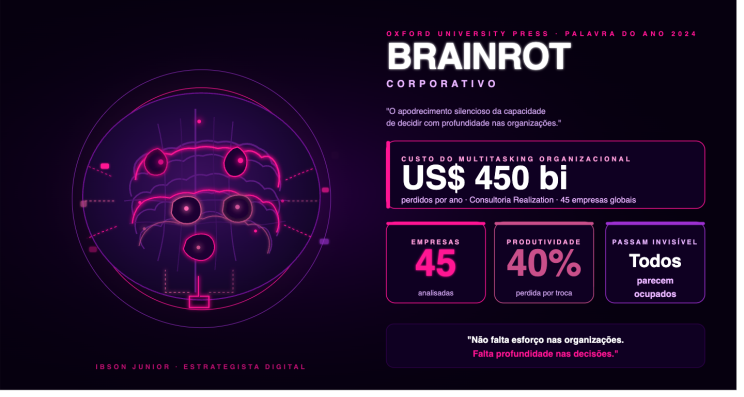
I really like the term Brainrot, literally “rotting of the brain”, which was chosen by Oxford University Press as the word of the year in 2024 precisely because it describes what happens when people continuously consume a series of content that deteriorates the ability to maintain attention, tolerate boredom, read a long text. In short, it prevents concentration on anything that requires sustained mental effort. What few people know is that the ramification of this for organizations goes beyond what, for me, is always the worst of all: the sacrifice of human capital. The “rotten brain” is a systemic phenomenon that has direct impacts on what much of leadership always considers the greatest parameter: money.
One of the proofs of this is in a study by the consultancy Realization, which analyzed 45 large companies around the world, and estimated that organizational multitasking costs more than US$ 450 billion per year in lost productivity. And more: the study also showed that the problem usually goes unnoticed because everyone always seems busy and, therefore, must be performing well. In practice, however, much of the time is spent switching between tasks without completing any of them.
Whoever does not govern their own attention starts to operate on priorities they did not choose. This is the effect of the lack of control over one’s own mind, one’s own choices.
In corporate life, added to these are the impacts of the excess of placebo meetings. Rituals that should be emails. Emails that should be direct messages. A prolix communication that increases noise without increasing clarity. I have seen this up close: strategic meetings with stakeholders where no one manages to speak because there are too many people at once; where whoever speaks does not find attention because the others are on their second screen or simply too accelerated; where no one really listens, because everyone is reacting to parallel stimuli. And, in the end, comes the recommendation that makes things crystal clear: “whoever missed it can watch the call later.” Everything conspires to fill even more the backlog of someone who already lives in search of lost time.
This is not just a problem of efficiency. It is a problem of command. Each unnecessary meeting redistributes attention, dilutes priority and weakens clarity about what really matters. In the end, it is not about excess of communication, but about loss of direction.
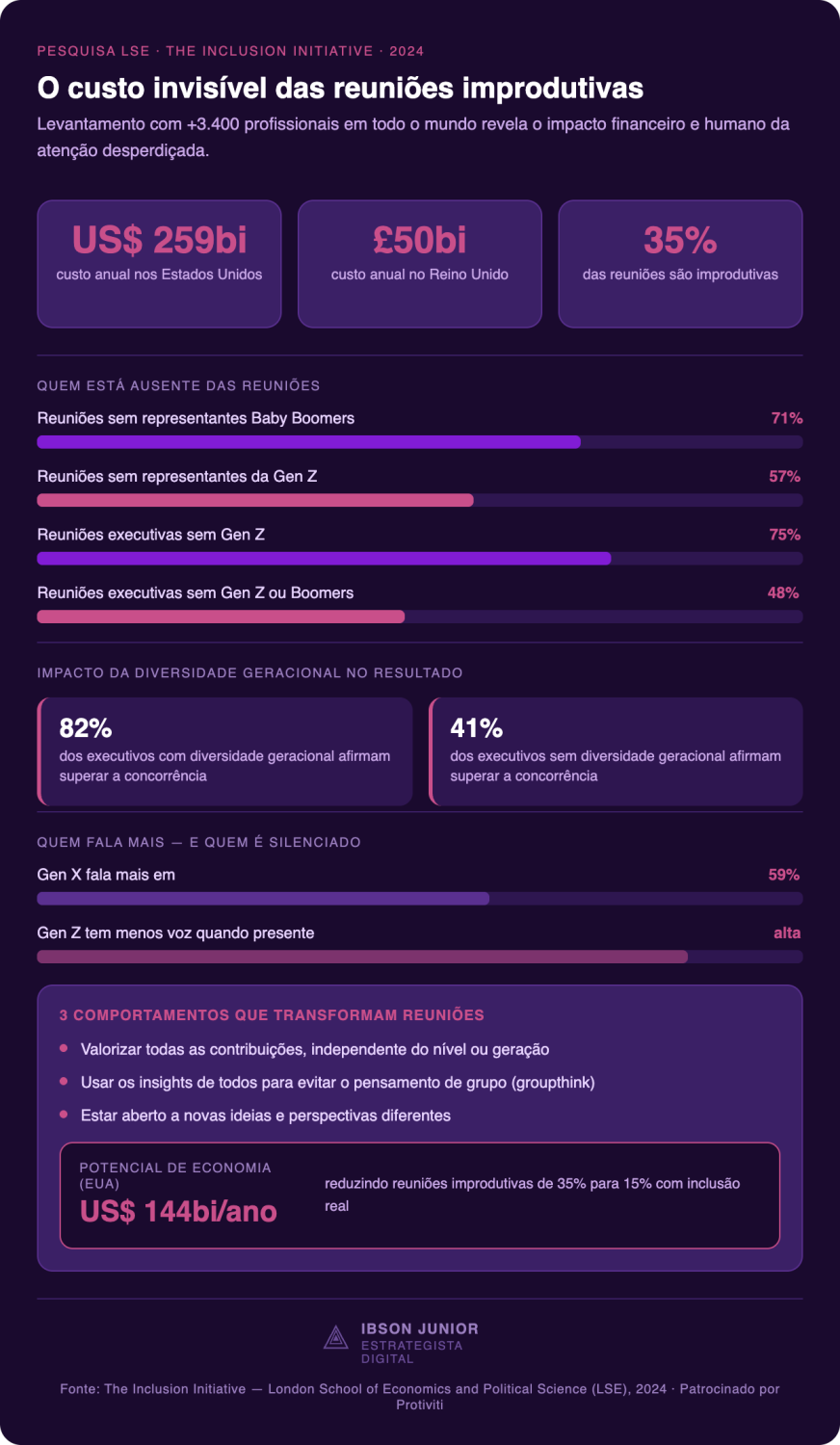
In October 2024, researchers from The Inclusion Initiative, of the London School of Economics (LSE), published a survey with more than 3,400 professionals and arrived at a number hard to ignore. Unproductive meetings cost North American companies US$ 259 billion per year. In the United Kingdom, the losses are on the order of £50 billion. More than a third of all corporate meetings are considered unproductive by the participants themselves.
At the top of the pyramid, the situation is not very different, only more sophisticated and hard to name. It is obvious that no executive, especially at the C-Level, can go public with impunity admitting their own brainrot. However, according to a survey by Harvard Business Review with 182 senior managers from different sectors, 65% of them state that meetings prevent them from completing their own work, and 71% classify them as unproductive and inefficient.
Presence does not mean decision. Movement is not always progress. When this clarity is missing, time ceases to be an agenda and becomes a field of dispute and control.
Synapse hijacker: intelligence or artificial urgency?
We are reaching the most ironic point of this great pandemic of digital saturation. That moment which, in a way, closes the cycle. While people progressively lost the capacity for concentration, for depth, for staying in creative discomfort, a tool emerged that promises to solve all of that with a prompt. What I observe is that artificial intelligence, which should be a support tool, is starting to be used as a definitive shortcut for thinking.
It causes me apprehension to perceive that AI is deployed with enthusiasm and even as an imperative within companies as a magical solution to reduce the work of 10 people, done by a single person, in just 10 minutes. It seems economical and rational, doesn’t it? But at what real cost? Do these solutions, conclusions and new ideas hold up over time or did they merely save, on the surface, a few dollars in that moment? What are the metrics, after all? Are they measuring real results and impacts or just running a scavenger hunt? The tool can, yes, enhance thinking, but when thinking is shallow, it only amplifies superficiality with more efficiency.
This creates a silent risk in organizations: decisions begin to be made based on quick answers, and not on deepened reasoning. Speed starts to simulate intelligence. But, without density, it only accelerates errors at scale.
If it is not used with human intelligence and critical sense, AI will only shorten reasoning, reduce authorship and create cognitive dependence for making decisions of human impact. These can be disastrous consequences on the individual and collective levels.
It is not about criticizing innovation or preaching a return to the past, since AI can be a great ally for those who know how to conduct it. What worries me is observing how much the level of demand has fallen. Everything begins when ChatGPT delivers an answer, the person accepts it. It delivers another, the person accepts again. Except that quickly, everything becomes automatic. The instinct to question, pressure and refine disappears along with the cognitive muscles that stopped being trained. That is when artificial intelligence starts to easily deceive those who have already given up on thinking with depth.
We are in the era in which attention ceases to be merely a mental state to become a scarce economic asset, disputed, exploited and, increasingly, structured as currency for a system that degrades the ability to use it. In this context, the decision that depends on qualified attention becomes directly impacted: we decide faster, but with less depth. We gain speed, we lose density. And when speed becomes the dominant value, what deteriorates is not just the quality of the decision, but the very human protagonism over the act of thinking.
What needs to return to the center
The article you are reading is not against technology, nor against social networks, or even the cell phone. The point I would like to highlight is the lack of clarity about how to use all of this in our favor, without harming our cognitive capacities and our firmness in making decisions. Because I work daily, not just leading, but collaborating with many people in corporate operations, I do not perceive a lack of effort. The great issue is in the direction of efforts and in the normalization of reactivity, in the excess of activation without depth and in the confusion between occupation and construction.
If poorly programmed, the best machines only work aimlessly, in a great waste of engineering. Our brains cannot become white elephants in disuse in decision rooms, nor can we become hostages of the tools that the human brain created. Perhaps the very conflict of generations can bring us some clues about how to train our brains to keep our capacities intact: if generation Z is, paradoxically, being the most consumed and the one that most seeks answers in the analog world, why can’t we? The younger ones are seeking to write by hand, a skill they never developed, because they perceive that memory needs manual training. Not unanimously, but with a speed of awakening that previous generations did not have. Will it be them, the following generations, who will pull us off the plug, even if partially?
Contemporary leadership requires a rare synthesis: the ability to integrate historical perspective, the agility of the present and the anticipated vision of the future. The bottleneck of modern organizations is no longer access to technology or information, but the crisis of attention.
Productivity and the quality of the decision are no longer questions of time management, but of managing cognitive energy. This transition requires that the governance of attention be treated as a new strategic KPI, ones we need to reflect on and create based on the reality and the future we want to build.
The lucidity of leadership needs to manifest in the ability to combat decision fatigue, recognizing that cognitive energy is a finite resource. By institutionalizing periods of digital silence and replacing alignment meetings with asynchronous communications, leadership reduces artificial urgency and preserves clarity of intention for what is truly strategic. The future of work, therefore, will not be defined by the tools, but by leadership’s ability to act as a guardian of intellectual capital, turning the company into an environment where quality thinking is protected to ensure the perpetuity and innovation of the business.
What most disturbs me is not just where we are, but where this is taking us. At what moment did we stop using technology and start being conducted by it? Are we still in control or have we already, in some way, been plugged into a system that disputes our attention all the time without us realizing it? I, personally, want to believe there is still time to invert this logic. That it is possible to leave automatic consumption, cheap dopamine, and regain a greater level of protagonism over what we think, decide and build.
To conclude this reflection, I invite you to answer me with sincerity. According to your experience, in environments that dispute attention all the time, what is still being conducted by real intention? What has already come to operate only by capture, habit and reaction? And how do you believe we can change this in a systemic way?