Time is an ocean
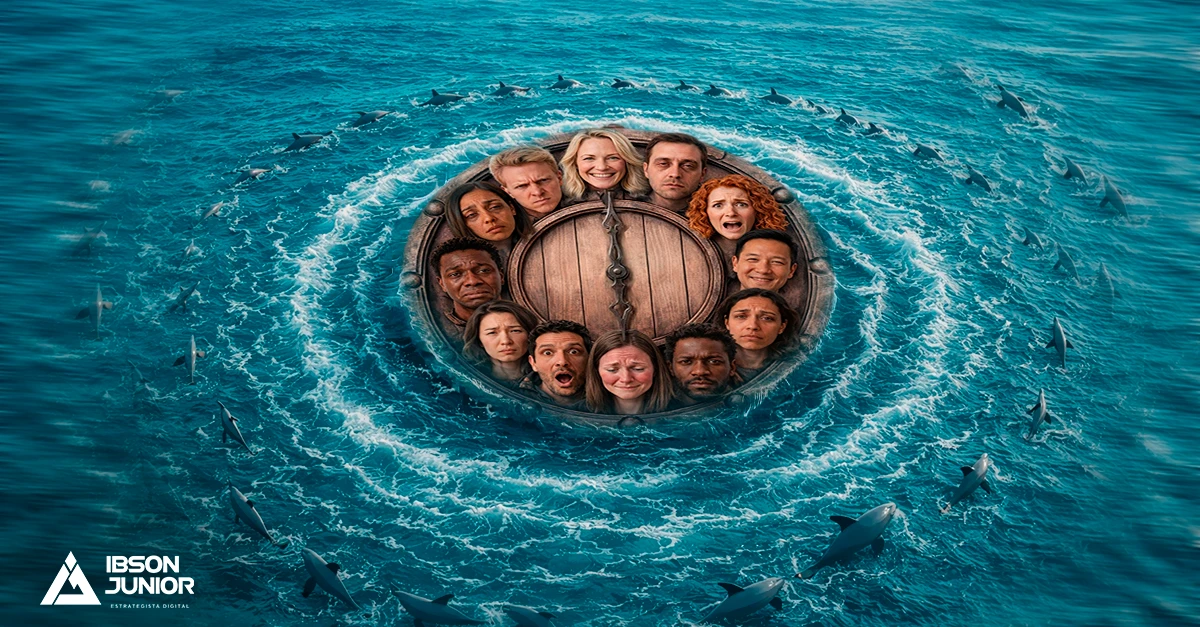
Time does not sink anyone. What sinks is sailing without direction.
We reach the end of 2025 with that feeling that seems to grow stronger with each cycle: that time passes too fast and that it was not possible to accomplish everything we would have liked. I have been observing this perception repeat itself in conversations with leaders, teams and professionals from different contexts. Depending on the audacity contained in the little list of goals from a year ago, we may even feel guilty or ashamed, struck by a suffocating frustration for many people. It is the paradox of the weight and the emptiness for everything that was left undone. In these moments, it becomes evident that time management is one of the most relevant themes of our time, both in corporate life and in our individualities. After all, time is a scarce asset, though we often do not give it its due value.
At the close of another cycle, a silent question arises that crosses many people: where did my time go? The feeling is diffuse, but recurring, that the days passed too fast and that control slipped through the cracks of the routine. It is in this context that everyday life reveals itself. It is six in the afternoon and the impression is that nothing advanced as it should. I procrastinated, got lost or spent the whole day dependent on the actions of others, which ends up breaking the flow and the continuity. The problem of time is not only individual, but also cultural and systemic. I always question myself whether we are living the present or trapped in a permanent state of imbalance, sorrowful about the past and anxious about the future. More than that, why is this feeling of lack of control over our own workflow so frequent?
A single day has 24 hours and 1440 minutes. How many minutes, over the course of this year, did we spend sucked in by distraction, by the anguish of choosing what to do or by the treacherous feeling of FOMO, Fear Of Missing Out (the fear of missing out on something)? While I write this article, how many times have I stopped to scroll my cell phone, go on social media or check a notification that could have waited? How many 90-minute meetings could have been an email to read in five? How much of the time in those meetings did we actually spend in full attention? And the most curious thing is that, at the end of the day, the feeling is not one of accomplishment, but of exhaustion. Time works like the sun of our lives, we orbit around it. But are we able to do something that is not simply spinning?
With the accumulation of commitments typical of the end of the year, such as rushed closings, last-minute meetings, balances, cross demands between areas and the company parties themselves, everything becomes more exhausting, but the work still needs to be delivered, culminating in what the greatest symptoms of December want to show us: the results of the lack of planning, of the excess of last-minute demands and of false urgencies are very negative. The chaos of December is rarely a surprise, it is almost always a consequence. The poor dialogue between areas with distinct priorities such as Sales, Finance, Marketing and Operations contributes to things exploding at the last minute, making it clear that the company’s priorities had been lost sight of. There is a lack of vision of the whole and there are no clear priorities. And now? If the problems of every month or every week accumulate until they become an avalanche of pending items, the resulting overload can amputate the culture.
We should be using this December both to close the cycle and to understand whether we are prepared for what is coming. Or whether it is going to be just another year of surprise after surprise.
Selectivity: with whom and on what we should spend our time
In in-person work, it is usually difficult to dodge the colleagues who only show up out of interest, with artificial flattery. These people consume our time and it is important to identify this as quickly as possible, avoiding exchanges and sharing that lead nowhere and limiting this contact to the essential. Learning to make this selection is not coldness, it is self-awareness. With the cell phone in hand, these approaches have become harder to escape, because we receive messages even outside working hours, with professional conversations invading our leisure and rest. For this reason, we should make conscious selections, prioritizing what and who is truly relevant.
When I arrived at the metaphor of the ocean and of sailors for the title of this text, I also thought that the management of time and tasks is represented in the seas, in sports such as sailing. Winning a regatta requires regularity and consistency to fulfill strategic plans, at the same time that it demands resilience and flexibility to deal with the unexpected. It requires awareness to understand the moment to take control or to adapt to the storms, letting the wind carry you, or even taking advantage of the tide.
Professional surfers have a maximum time to choose the best waves; you cannot surf all of them. A giant wave like those of Nazaré can penalize your mistake with an irreversible consequence, especially if that wave is a pile-up of accumulated problems. Planning, strategy, intuition and training to execute the maneuvers are tasks in the face of the countdown.
Leadership, workflow and annual planning
Everything is time. No wave would be so big and dangerous with more planning, with solutions implemented at the correct timing. Whether to avoid the tsunami, or to surf giant waves safely, we need to work with anticipation. Processes and workflows are useful even for abandoning the impracticable points of a planning that is beautiful in theory. It is not possible to leave everything to the last minute and expect excellent results. Even improvisation, which should not be the rule, needs a base to happen.
The treadmill on which leaders walk never moves slowly. Leaders are activated by the leadership above them, by distinct objectives and by the interface with other areas, at the same time that they deal with short deadlines and high demands from their team members. Without effective time management, one runs the risk of not doing things efficiently, or simply failing to do them. There is a real risk of becoming an omissive leader. A leader who does not participate, does not follow up, does not train their team members.
That is where emotional intelligence comes in, because the leader needs to understand the scenario, decide the right time to enter the sea. The leader who manages their time may still be on the sand, but knows that, when they enter the sea, they will stay there for a certain time. Part of that time in the shallows, part in the deep. The unexpected will be part of it and being prepared is fundamental. You have to calculate what to do if you need to stay longer, spend energy on other things. To generate their own framework and have a stable base for storms, the leader needs to understand their mission, priorities, general and specific objectives, expectations of the upper levels. The framework also needs to answer the following questions: How does this become operation? How does it become process, day to day, communication, planning, implementation, training? How to distribute one’s own time according to this ecosystem?
Or even, what is more relevant: People? Culture? How much time should be given to that? How much time to spend on strategy? How many meetings are really efficient? How many can I delegate and to whom?
I see the figure of the leader almost like someone in an observatory, looking through the telescope, studying the celestial movements. From this study comes the lucidity to understand what, within the priorities, is viable and achievable, whether there is a traceable path to get there. When not all of the year’s script is possible to fulfill, what can I give up, both in personal and professional planning? There are more optional items than we imagine and the truly indispensable things may leave other plans behind. And that is fine.
The important thing is that, at the end of the year, the following feeling prevails: “I managed to do only 50% of what I wanted, but those crucial 20% are delivered.”
This is the minimum acceptable in good time management, both personal and professional. If ten of 20 items planned for the year are delivered, that is great, as long as the delivered items keep everything pulsing. The rest can be left for next year, but always with a vision of strategy, tactics and operation. Each of these stages requires dedicated time. Taking the first steps is fundamental, precisely so as not to stay still, even if other priorities prove more urgent.
No time for self-deception: emotional intelligence and personal truth
Emotional intelligence and self-knowledge distance us from self-deception. You have to understand with maturity what our personal truth is and realize that we are not Superman or Wonder Woman, we cannot do everything well at the same time, much less all the time. We can be vulnerable in many moments. Time is a mirror of human relationships and acts as an ally when we perceive how many people are true within their own convictions and which of them manage to remain ethical and faithful to their principles when placed in adverse situations. If I need to earn more money, but to do so I need to corrupt my values, is it worth spending my time in that place, in that role?
Leaders are frequent targets of flattery and self-deception on the part of those who want to be promoted and resort to artificial behaviors. An emotionally mature leader knows when someone approaches out of interest and when that person is not focusing on their own attributions. A vain or arrogant leader can delude themselves.
On this, I share a learning about time and focus: doing one thing well, every day. Whoever maintains this constancy, at some point, will be promoted, and if not, will understand that that place is not for them. Even better if they have used their time at the company to improve, to invest in their expertise. This person loses nothing, the one who loses is the company. It is the company that wastes its time with flattery. A leader surrounded by people easily led into self-deception cannot build a high-performance team because they are being corrupted by someone who, paradoxically, has more emotional intelligence than they do. Meanwhile, other people, better prepared, may feel wronged and leave.
A leader needs to know how to separate emotions in order to be assertive. They can be human, vulnerable, lighten up a conversation, but they cannot lose the authority of their position. They cannot mischaracterize who they are and the position they occupy. Favoritism is a disrespect to everyone’s time. Whoever is caught in the middle loses belonging to the culture and becomes averse to leadership, acting with tolerance, but without real engagement. This often does not recover as time passes.
”I should have cared less about small problems…”
Time is life. In the film “In Time” (2011), the character Will Salas, played by Justin Timberlake, literally becomes a “time counter”. In the plot, time replaces money and there is an allegory about work, ethics, social classes. People stop aging at 25 and come to have a clock on their arm that shows how much time of life they still have. To work is to earn time. To spend is to lose time. When the counter reaches zero, the person dies. Will Salas starts with very little time of life, but comes to circulate among social classes radically separated by the “balance of life”. The rich have centuries, because they can buy time; the poor live day to day, always running against the clock. The film brings the perfect metaphor about what time buys: calm, lucidity and freedom of decision. At the limit, time is the scarcest good in the law of supply and demand, its price is high.
The now is life, today too; just like air, physical health and our energy. Where we place energy, we also place time. Wind energy, for example, is generated by the wind, an invisible good. However, we can see the rotating blades and benefit in a tangible way from the energy generated by moving air, in a repetitive and conscious way. Where does the energy we produce by the simple fact of thinking, of worrying, of living cornered by so much anxiety, stress, burnout go? We need to take control of our time with the clarity that only emotional intelligence can bring. All of this so as not to be victims of the “Epitáfio” syndrome, the lyrics of the Titãs song that say: “I should have complicated less / worked less / seen the sun set”. Reaching a certain age, or already at the end of life, and realizing that time passed and you did not accomplish your dreams, did not leave stagnations, did not change what you could have changed.
Regardless of the limitations and obstacles, we are authors of our lives and we must take responsibility for the consequences of our actions and inactions. Time exists, but we exist within time. It is in the now, in today, that choices truly happen. It is the conscious decisions of the present time that determine the fruits we will reap in the future. Only emotional intelligence allows us to be in control, to understand the rhythm, adjust the route and sail consciously, instead of merely being carried by the currents. Learnings only consolidate after many attempts, errors and corrections. And the earlier we learn from them, the more time we will have to get it right. There is still time, as long as there is awareness. May this reflection go with us into the approaching 2026, and may what we did not accomplish in 2025 turn not into guilt, but into a driver for better, more intentional choices and for our personal success.